





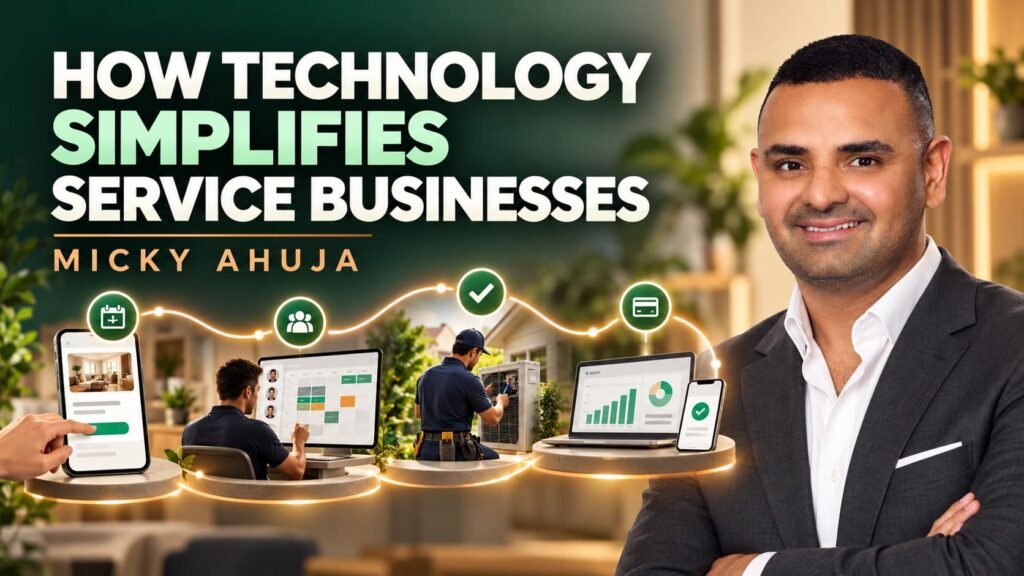
Technology has become essential for service businesses that want to improve efficiency, deliver consistent customer experiences and grow without creating unnecessary operational complexity. However, purchasing more software does not automatically make a company better organised. When different departments use disconnected platforms, employees may enter the same information several times, customers may receive inconsistent updates and managers may struggle to understand what is happening across the organisation. From Micky Ahuja’s perspective, the purpose of technology in a service business should be to make work clearer, faster and more reliable. The right digital tools should remove repetitive tasks, connect important information and help employees serve customers effectively without forcing the business to manage complicated systems that provide little practical value.
Begin With the Business Problem
A service business should define the problem it wants to solve before selecting any technology. For example, the real issue may be missed appointments, slow customer responses, inaccurate invoices, poor workforce visibility or inconsistent service delivery. Without identifying the cause, a company may invest in an advanced platform that adds features but fails to improve the underlying process. Leaders should map how work currently moves through the organisation, identify delays or duplication and determine what a successful improvement would look like. A simple scheduling tool may create more value than a large enterprise platform if it addresses the business’s most important operational challenge. Technology should support a clear objective rather than becoming an objective by itself.
Reduce Repetitive Administrative Work
Employees in service businesses often spend significant time completing routine administrative tasks such as entering customer details, confirming appointments, preparing invoices, updating job records and producing reports. Business automation can reduce this workload by allowing information to move automatically between connected processes. An online booking can create a customer record, notify the assigned employee, send a confirmation and schedule a reminder without requiring several manual actions. This does not remove the need for people; it allows them to spend more time solving customer problems and delivering services. Micky Ahuja’s business approach emphasises using systems to improve employee productivity while maintaining accountability. Automation is most valuable when it removes predictable, repetitive work without making the customer experience feel impersonal.
Improve Customer Communication
Customers expect service providers to communicate clearly and respond within a reasonable time. Technology can support this expectation through automated confirmations, appointment reminders, progress notifications and organised records of previous conversations. A central customer management system helps employees understand what the customer requested, which services have already been delivered and whether any issue remains unresolved. This prevents customers from repeating the same information to different departments. However, automated communication should be written carefully and used in the right situations. Complex complaints, sensitive concerns and unusual requests still require human judgement. The goal is to use technology for routine updates while ensuring employees remain available when customers need personal assistance.
Give Managers Better Operational Visibility
Service businesses depend on accurate information about employees, appointments, workloads, customer requests and financial performance. When this information is stored in separate spreadsheets or informal messages, leaders may make decisions based on incomplete or outdated data. Centralised dashboards can provide a clearer picture of current operations, showing which jobs are complete, where delays are occurring and whether teams have suitable capacity. Workforce management technology can also support scheduling, attendance, task allocation and performance monitoring across different locations. Better visibility enables managers to respond earlier, distribute work more fairly and identify patterns that may otherwise remain hidden. Reports should focus on useful measures rather than overwhelming managers with data that does not influence decisions.
Choose Technology Employees Will Actually Use
A powerful system creates little value when employees find it confusing or avoid using it. Service businesses should involve the people who perform the work when evaluating digital tools because frontline employees understand the practical difficulties within existing processes. A platform should be straightforward, accessible and suitable for the working environment. Mobile access may be essential for field-based teams, while office employees may require integration with existing communication and financial systems. Training should explain not only how to use the technology but also why the change is being introduced. When employees understand how a tool will reduce duplication, improve customer service or simplify reporting, they are more likely to adopt it consistently.
Avoid Building a Complicated Technology Stack
Businesses sometimes purchase new tools whenever a problem appears, creating a collection of subscriptions that do not communicate with one another. This increases cost, training requirements and data-management risk. Leaders should regularly review which platforms are being used, whether features overlap and whether information can move securely between systems. Consolidating tools may simplify operations, but the cheapest platform is not always the best choice. Reliability, support, security, usability and integration should all be considered. According to Micky Ahuja, technology decisions should strengthen the operating system of the business rather than introduce another layer of administration.
Measure the Real Business Impact
Technology should be evaluated according to measurable outcomes. A service business can review whether a new system has reduced response times, improved scheduling accuracy, lowered administrative hours, decreased errors or increased customer satisfaction. Implementation and maintenance costs should also be compared with the value created. If employees continue using the old process alongside the new one, the expected efficiency may never appear. Regular reviews allow leaders to remove unnecessary steps, provide additional training and adjust the system as business requirements change.
Final Thoughts
Technology can simplify a service business when it solves defined problems, supports employees and improves the flow of reliable information. The strongest approach is to automate repetitive work, centralise essential records and give managers better visibility without replacing the human service customers value. From Micky Ahuja’s perspective, successful digital transformation is not about having the greatest number of tools. It is about selecting practical technology that makes the organisation easier to manage, easier to scale and better equipped to serve its customers.