





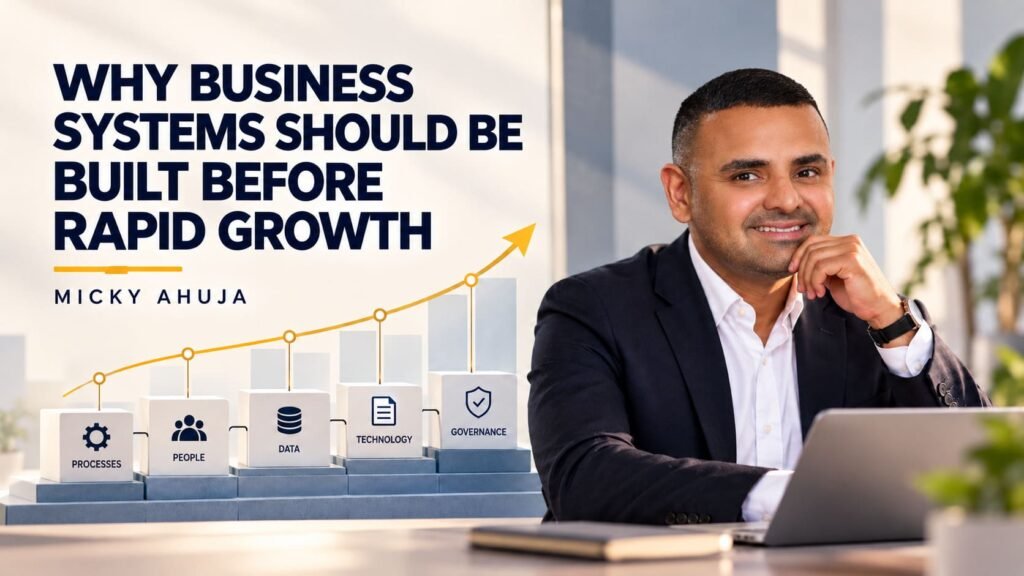
Rapid growth is an exciting stage for any business, but it can also expose weaknesses that were easy to manage when the organisation was smaller. A founder may personally approve decisions, answer customer questions, monitor employees and solve operational problems during the early stages. As demand increases, this approach becomes difficult to sustain. More customers, employees, locations and transactions create additional complexity, and informal working methods can quickly lead to delays, inconsistent service and costly mistakes. From Micky Ahuja’s perspective, business systems should be established before rapid expansion so the company can grow without losing control over quality, finances or customer relationships.
Growth Magnifies Existing Problems
Expansion does not automatically improve the way a company operates. In many cases, it magnifies problems that already exist. A small communication gap can become a major source of confusion when several departments are involved, while an inefficient approval process can delay hundreds of transactions instead of only a few. If responsibilities are unclear, employees may duplicate work or assume that someone else is handling an important task. Leaders should therefore examine how work currently moves through the organisation before increasing its volume. Fixing operational weaknesses early is usually less expensive and disruptive than attempting to redesign processes while the business is managing rapid growth.
Document Important Business Processes
A scalable business should not depend entirely on knowledge stored in the founder’s mind or understood by only one experienced employee. Important activities such as customer onboarding, sales follow-up, purchasing, service delivery, invoicing and complaint handling should be documented clearly. Standard operating procedures give employees a reliable reference and help managers maintain consistency as new people join the organisation. Documentation does not need to become unnecessarily complicated. It should explain what must be done, who is responsible, which tools are required and how successful completion is measured. Clear processes reduce reliance on memory and make employee training faster and more consistent.
Define Roles and Decision-Making Authority
Rapid growth often creates confusion about responsibility. Employees may be given new tasks without understanding who can approve spending, resolve customer issues or change an established process. When every decision returns to the founder, the organisation develops a bottleneck that slows progress and places excessive pressure on one person. Micky Ahuja’s approach to business leadership emphasises that accountability must be supported by suitable authority. Leaders should define roles, reporting lines, spending limits and escalation procedures before expansion accelerates. Employees can then make routine decisions confidently, while senior management remains focused on strategic matters and higher-level risks.
Choose Technology That Supports the Process
Technology can help a growing company manage customer information, employee schedules, inventory, finances and performance data. However, software cannot repair a process that has not been properly understood. Purchasing multiple platforms without a clear plan may increase costs and create disconnected information across departments. Businesses should first identify the operational problem, define the desired workflow and then select technology that supports it. Systems should be practical, easy to use and capable of integrating with the organisation’s existing tools. Automation is most valuable when it removes repetitive work, reduces errors and gives managers better visibility rather than adding another administrative burden.
Build Financial Controls Before Spending Increases
Growth usually requires investment in recruitment, marketing, equipment, technology and working capital. Without financial controls, spending may rise faster than revenue or cash collection. Businesses should establish budgets, approval limits, cash-flow forecasts and regular financial reporting before making major expansion commitments. Leaders also need to understand the full cost of acquiring customers, delivering services and entering new markets. A contract may generate impressive revenue while producing limited profit or creating cash-flow pressure because of delayed payment terms. Strong financial systems allow entrepreneurs to evaluate opportunities using reliable information instead of assuming that all growth is profitable.
Create Meaningful Performance Measures
Business systems should make performance easier to understand. Leaders need a small number of useful indicators that show whether operations are becoming stronger or weaker as the company expands. These may include customer satisfaction, service quality, productivity, employee turnover, delivery time, profit margins and outstanding payments. Measurements should support better decisions rather than exist only for reporting purposes. When managers review performance regularly, they can identify problems early, understand why one team is performing better than another and share successful practices across the organisation. Consistent information becomes particularly important when the business begins operating across multiple locations.
Protect Customer Experience and Company Culture
Customers expect consistent service regardless of how quickly a company is growing. If demand increases before adequate systems are introduced, response times may become slower, errors may rise and employees may provide different answers to the same question. Internal culture can also weaken when new employees receive limited training or unclear guidance. Documented values, structured onboarding and reliable communication help preserve the organisation’s identity during expansion. Systems should not remove human judgement or flexibility; they should give employees a stable foundation from which to deliver a dependable experience.
Final Thoughts
Building business systems before rapid growth is not about creating unnecessary rules. It is about preparing the organisation to handle greater complexity with confidence. Clear processes, defined responsibilities, suitable technology, financial controls and meaningful performance measures allow a company to expand without becoming dependent on constant intervention from its founder.
From Micky Ahuja’s perspective, sustainable business growth begins with a strong operational foundation. When systems are built early, employees can work more effectively, customers receive consistent service and leaders gain the visibility needed to make informed decisions. Growth then becomes a controlled opportunity rather than a source of avoidable disruption.